India’s port sector sits at the intersection of structural tailwinds — a rapidly expanding economy, a policy push toward domestic manufacturing through Make in India and PLI schemes, and a geography that places the country astride major global shipping lanes. Against this backdrop, this review examines Adani Ports and Special Economic Zone (APSEZ), India’s largest commercial port operator by cargo handled.
APSEZ operates a portfolio of 15 domestic ports and terminals alongside an expanding logistics business and a nascent international presence. The company handles approximately 27% of India’s total port cargo and has built out capabilities across rail, road, warehousing, and inland logistics — positioning itself as an integrated port-to-gate operator rather than a pure-play port business. This review assesses how well the business is positioned to benefit from India’s trade growth, where execution risks lie, and what the financials reveal about the quality of the franchise.
Key Strengths
#1 Market leadership and Scale
APSEZ is India’s largest private-sector port operator, with a diversified portfolio of 15 domestic ports and terminals across the country’s coastline and a significant presence in containerised cargo movement. The company has a total cargo handling capacity of 653 Mn tonnes, reflecting its scale of operations. APSEZ currently handles approximately 27% of India’s total port cargo, underscoring its leadership position in the domestic market. In addition, the company has established an international presence, operating ports and terminals in Tanzania, Sri Lanka, Israel, and Australia. Its scale provides a structural advantage, allowing the company to spread fixed costs over higher volumes, thereby improving efficiency and supporting above-average operating margins (relative to competitors).
The company derives approximately 45% of its cargo volumes from containerised trade, which is typically the highest-margin segment, with margins exceeding 50%. In contrast, dry bulk cargo—including coal, coking coal, and iron ore—accounts for 45% of cargo volumes but operates at comparatively lower margins. Liquid cargo, particularly LNG, represents a high-margin segment but currently contributes only ~2% of total volumes.
This segment has significant growth potential, as the company plans to expand LNG bunkering operations at its ports in Dhamra and Vizhinjam. India remains a net energy importer, with a significant portion of its requirements—such as crude oil, LNG, and coal—sourced from regions including the Middle East and Russia. As part of the ₹16,000 crore Phase 2 capex at Vizhinjam, the company is developing a liquid terminal along with infrastructure to support India’s first ship-to-ship LNG bunkering operations.
Here’s a quick look at APSEZ’s volume mix :
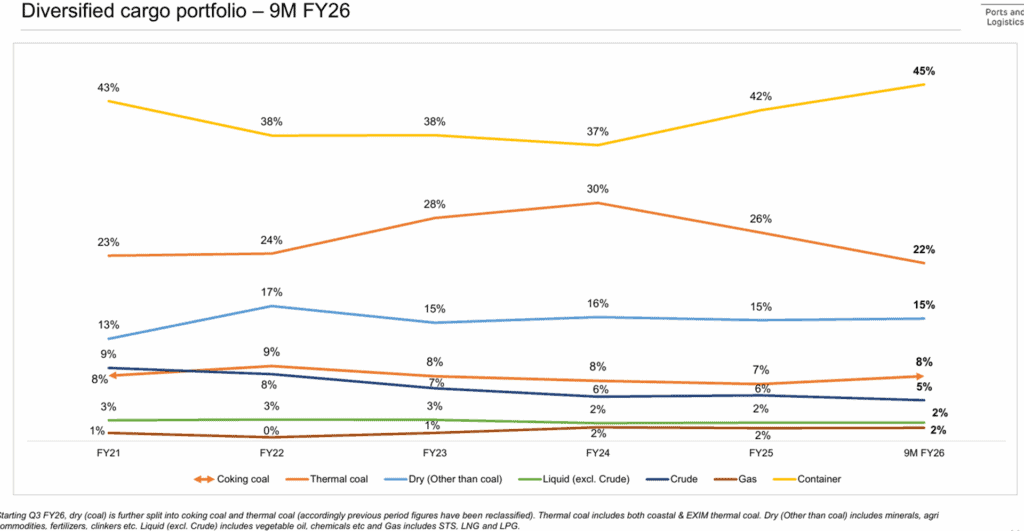
Source: Adani Ports & Special Economic Zone Q3 & 9M FY 2026 Results Presentation
APSEZ is undertaking significant capital expenditure to further enhance operational efficiency across its ports. Investments in advanced cargo handling equipment have improved container throughput, with the company achieving a gross crane rate of approximately 30 moves per hour, matching regional benchmarks (Colombo at ~34 and Jebel Ali at ~26 moves per hour).
#2 Integrated logistics operations
APSEZ is evolving from a pure-play port operator into an integrated port-to-gate logistics provider, with a focus on improving connectivity to hinterlands, economic centres, and industrial hubs. Its logistics capabilities enable multi-modal transportation solutions, allowing customers to move goods seamlessly without engaging multiple service providers. This integration reduces transportation costs, improves turnaround times, and enhances overall supply chain efficiency for customers. Smaller port operators are unlikely to match investments at this scale due to capital or space constraints.
This end-to-end approach allows APSEZ to compete with other port operators for volume based on its end-to-end service capabilities in a time-bound manner.
#3 Developing India as a transhipment hub
India’s geographic positioning provides a structural advantage in maritime trade and supports its potential to emerge as a global transhipment hub. With a coastline of approximately 7,500 km, spanning the Arabian Sea, the Bay of Bengal, and the Indian Ocean, India is located along some of the world’s busiest shipping lanes. Its position at the intersection of East–West trade routes, along with proximity to high-growth corridors such as India–Africa, places it in a favourable position to benefit from increasing global trade flows.
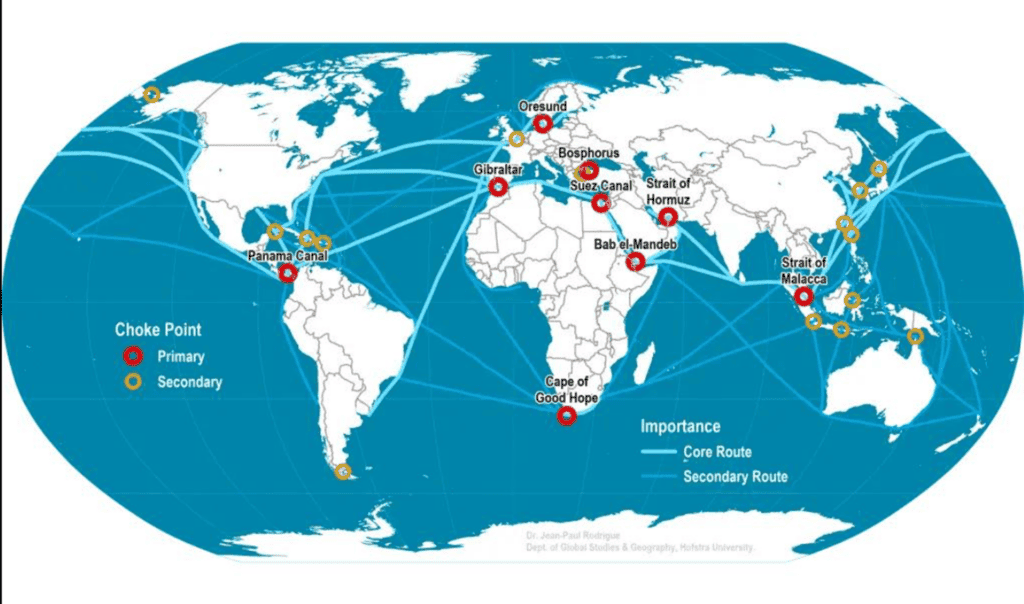
Currently, a significant portion of cargo originating from Indian ports is routed through foreign transhipment hubs, such as Colombo, Singapore, and the UAE, before reaching its final destination. India has historically been unable to capture this cargo movement due to the lack of deep-water ports capable of handling large transhipment volumes. This dependence on foreign ports results in additional costs of $80–$100 per container for traders. APSEZ is addressing this gap by developing the Vizhinjam and Mundra ports, both of which are designed to handle large vessels with deep-water capabilities.

Wondering Nifty IT Stocks Rally will it price bounce or a sector turnaround?.
Prime Velocity is a focused flexicap equity PMS built on a disciplined QQM framework — combining quantitative screening, deep qualitative research, and macro insights — to identify quality compounders at the right price, in the right marketcap allocation, at the right time.
Discover Prime Velocity →Vizhinjam, in particular, has a strategic advantage. It is located just 10 nautical miles from one of the busiest East–West shipping lanes, positioning it naturally within existing global trade routes. Recent disruptions, such as the closure of the Strait of Hormuz, have already led to the diversion of vessels, with approximately 100 ships calling at Vizhinjam. Given its ability to handle large volumes and operate efficiently, Vizhinjam is well-positioned to capture a meaningful share of global transhipment traffic over time.
A comparison of Vizhinjam and Mundra ports with Colombo Port—the primary transhipment hub for East–West trade and a key hub for Indian cargo—follows below.
We give three possible scenarios of the Vizhinjam in transhipment operations:
If it works as planned, Vizinjam will be a key scalable asset for Adani Ports in the coming years and contribute significantly to growth.
#4 Strong track record of financial Performance
APSEZ has demonstrated consistent year-on-year revenue growth, supported by strong operating performance. It has maintained robust EBITDA margins of approximately 60% and PAT margins of around 30%, reflecting its ability to sustain efficiency and withstand competitive pressures.
From a balance sheet perspective, APSEZ carries debt primarily in the form of long-term unsecured bonds, along with some short-term borrowings, but the leverage is manageable. APSEZ has demonstrated a disciplined and opportunistic expansion strategy over the past few years. It has acquired two ports through insolvency proceedings under the NCLT framework.
Assets such as Dighi Port (Maharashtra) and Karaikal Port (Puducherry) were acquired at attractive valuations, and a third asset is currently in the process of being acquired (Karanja Terminal). Despite multiple acquisitions to expand its asset base, it has demonstrated financial discipline by maintaining a stable leverage profile, with a comfortable interest coverage ratio of 5.26x and a debt-to-equity ratio of 0.7x, indicating a comfortable ability to service debt.
APSEZ has foreign-currency bond exposure of ₹27,648 Cr, largely linked to the US Treasury yields plus a spread. However, the majority of this exposure is hedged through derivative instruments, with only ₹7,094 Cr that is unhedged. The company also benefits from natural hedges through foreign currency income, while a portion of its revenue is dollar-linked despite being billed in INR, helping mitigate currency risk.
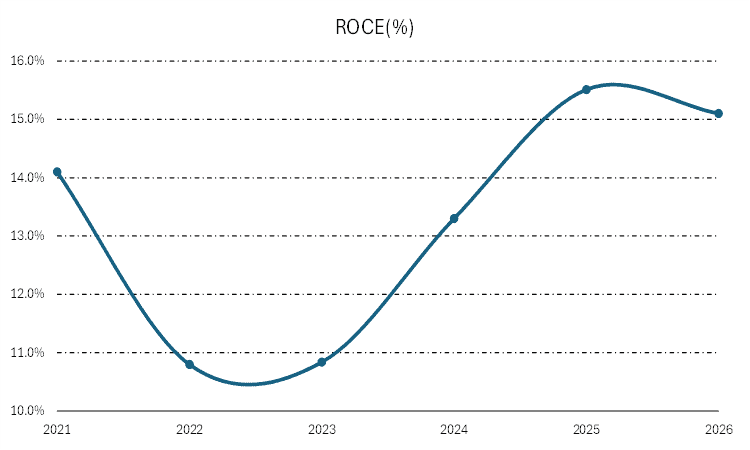
APSEZ has also consistently operated in the 14-15% RoCE band except for a few years in-between. RoCE has started trending up in the last 2 years and is expected to continue in this range going forward. The recent RoCE expansion has been aided by the following factors;
- Expansion of the logistics business leading to additional revenue streams
- A favourable cargo mix, with increasing contribution from high-margin container traffic and liquid cargo (LNG)
- The company’s ability to operate at scale, driving operating efficiencies
Risk Factors
- Global Economic slowdown: Port volumes are closely linked to global economic activity. A slowdown in global growth would reduce import and export volumes, directly impacting the company’s topline. Additionally, container traffic—accounting for approximately 45% of total volumes—is closely tied to consumption trends. As economic activity weakens, lower consumption could further pressure container volumes.
- Increasing geopolitical uncertainty: Rising geopolitical uncertainty has increased the frequency and intensity of global conflicts, marking a shift away from the stable post-World War II era. Recent conflicts, such as the Russia–Ukraine war and the Middle East conflict (Israel–Iran tensions), highlight the growing preference for military action over diplomacy. This instability poses risks for port operators, as ports are considered strategic national assets and can become targets during periods of conflict. For instance, Black Sea ports in Ukraine have faced repeated disruptions and attacks, affecting global trade flows. In this context, APSEZ has a significant presence along India’s western coastline and in the event of renewed hostilities with Pakistan, there is a potential risk that these ports could become targets, as adversaries may seek to disrupt trade and logistics infrastructure.
- Unfavourable government regulations, regulatory risk: The port industry is exposed to a range of regulatory risks, including changes in licenses and concessions, tariff controls, and environmental approvals. India’s port sector is gradually transitioning toward a landlord port model, where the government retains ownership of land and core infrastructure, while private operators manage assets and port operations. While the sector has moved toward market-linked pricing under the Major Port Authorities Act, there remains a risk of tariff caps being reintroduced, which could impact profitability.
APSEZ has a growing international footprint, with stakes in ports across multiple countries. While this provides geographic diversification, it also introduces regulatory and geopolitical risk. In the event of strained diplomatic relations, foreign governments may view Indian-owned port assets as a national security risk. Below are some of the concerns that have been raised by governments (in past instances):
- Potential use of port infrastructure for intelligence gathering near sensitive locations such as naval bases
- Concerns around control over critical supply chain infrastructure
Cabotage regulations remain another area of policy uncertainty. In 2018, the government relaxed cabotage rules, allowing foreign vessels to transport cargo along the Indian coast, improving capacity and efficiency. However, this exemption was recently withdrawn, which could increase logistics costs for exporters and importers and create congestion at ports.
Following industry pushback, the government has temporarily extended the exemption for another six months, with the current extension set to expire in October 2026. Currently, we are in a wait-and-watch mode with respect to the Cabotage regulations; future policy decisions on cabotage will be an important variable influencing port traffic and operational efficiency.
Valuation
At an EV/EBITDA of 17.8x, APSEZ trades at a premium to its peers. This premium may be attributed to its positioning within a higher-growth phase, while many competitors operate in relatively mature markets with slower growth trajectories. The multiple drivers that may be supporting this valuation at present would be the expansion of Vizhinjam port, increased utilisation of existing assets, and the scaling of its value-added logistics business.
APSEZ currently handles approximately 653 million tonnes of cargo, with a target to reach 1 billion tonnes by 2030, translating to a healthy volume CAGR of 11-12%. This could further translate into higher revenue and an improved EBITDA CAGR with improved utilisation at many of its recent capacity additions. Despite quoting at a premium valuation, APSEZ deserves to be under the radar for investors due to its significant alignment with India’s trade and manufacturing-led growth trajectory.
This is a review of the above discussed stock and should not be construed as a recommendation or advice.
General disclosures & disclaimers

Let experts manage your wealth
At PrimeInvestor, our Portfolio Management Services are built on one principle: protect on the downside, compound on the upside. Whether you’re starting your wealth journey or looking to bring discipline to an existing portfolio — we have a strategy for you.
Explore our PMS →