With inputs from Srikanth Srinivas
This report is a continuation of our earlier article, “Nifty IT Stocks Rally: Price Bounce or Sector Turnaround?” While that article laid out the framework we use to distinguish a genuine sector turnaround from a sentiment-driven rally, this report applies that framework to the Q1 FY27 earnings of India’s leading IT companies. We examine whether the recent rally is now finding support in fundamentals.
The answer is not simple. We think part of this rally is mechanical, a meaningful chunk of bearish positioning got unwound in a matter of days. But part of it also has real support in numbers – to what extent, we explain below.
On the mechanical part of the rally: one explanation currently doing the rounds is that the rally is less about Indian IT itself and more about a shift in global investor positioning. As concerns grow over the sustainability of AI-driven valuations in semiconductor-heavy markets such as Taiwan and South Korea, some investors are rotating towards Indian IT services as a non-AI driven technology exposure. This a tactical portfolio reallocation rather than a fundamental shift.
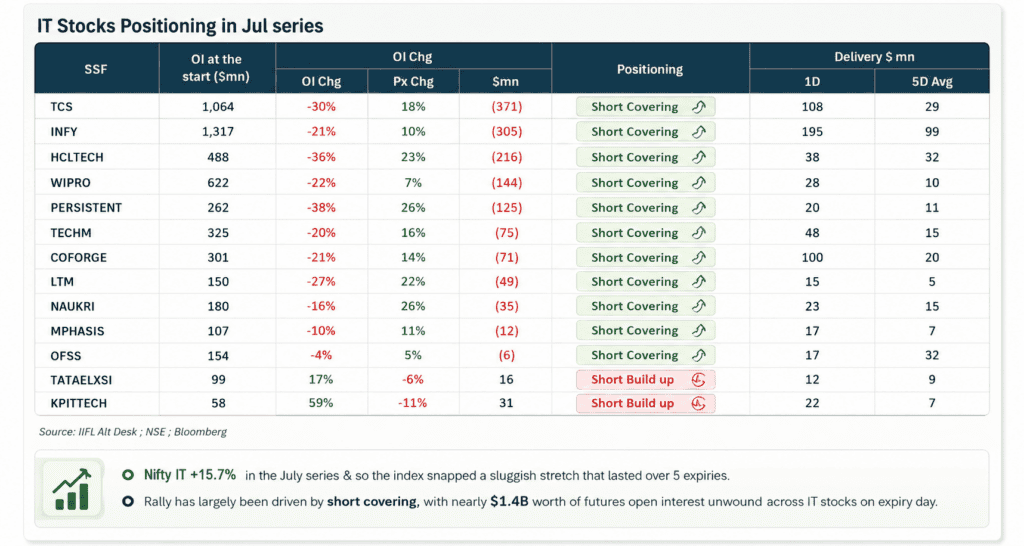
But to generate meaningful returns from a sector, it is important to separate price movements from a fundamental change. We therefore took a hard look at the recent earnings performance of Indian IT services companies, to gauge how their fundamental prospects are changing.
A steady quarter for IT sector, not a break-through
We look at 6 frontline IT companies – TCS, Infosys, HCL Tech, Wipro, Tech Mahindra and LTM (previously LTIMindtree) that have reported their Q1 FY27 numbers, alongside their vertical-level growth, workforce data, and their own guidance. Here’s what we found.
Revenue growth across the pack was muted, offer little grounds for betting on a turnaround. Three of the six companies grew in constant-currency terms sequentially, Infosys (+1.0%), Tech Mahindra (+2.6%) and TCS (broadly flat, +0.4%), while HCL Tech and Wipro contracted slightly.
However, operating profits grew year-on-year at every single company, from high single digits to over 50% at Tech Mahindra.
Where margins improved though, the gains could be traced mostly to cost items such as the timing of wage hikes, restructuring roll-off or currency gains rather than companies regaining pricing power. The distinction matters because it has helped margins look resilient. However, management commentary undermines this picture of resilience.
Managements across the pack have flagged that AI-linked productivity pass-throughs on contract renewals typically run at 10-15% on large deals. This means a client renewing an existing contract is now looking to pay meaningfully less for the same project scope, because AI tooling is now assumed to do part of the work.
AI-driven productivity pass-throughs reduce the value of the existing revenue base. They can be offset only if new AI transformation deals scale fast enough to replace the lost billing. If new deal-signing falls behind the reduction in billing, margins could give up several hundred basis points within a year, even without revenue shrinking as much.
Deal books healthy, but not for everyone
We think the strongest fundamental support for an Indian IT services rally needs to come from order books. This is the thesis that even if use of AI in their own operations reduces billing rates for software majors, this will be more than made up by a manifold expansion in their AI transformation deal wins from clients. But actual results show patchy progress in this metric.
Yes, HCL Tech booked its highest-ever first-quarter deal value, up 24.3% sequentially and a third higher than a year ago. Infosys’s large-deal wins rose 12.5% sequentially, with 61% of that classified as net-new business rather than renewals. But Tech Mahindra and LTIMindtree posted steady, tnot spectacular, deal numbers.
TCS is the one name where the headline belies the underlying picture. Its $9.5 billion in quarterly deal wins sounds impressive next to peers, but it’s actually a 20.8% sequential decline, and the pace of new mega-deal signings slowed to one this quarter from three in the previous one. Placed against its own history, this quarter’s number sits well within the range TCS has already delivered over the past year and this tempers any suggestion that AI-led demand is now accelerating.
IT Workforce: A smaller supporting clue
Workforce data points in the same direction. TCS is the only company adding people organically at scale this quarter – nearly 9,300 net additions – while HCL Tech, Tech Mahindra and LTM all reduced headcount, and Wipro’s reported net addition disappears once you strip out an acquisition. With utilisation still in the mid-to-high 80s at the companies that disclose this metric, there’s bench capacity to absorb more work before anyone needs to hire meaningfully. This looks less like the next big growth story is around the corner. It indicates companies choosing to monetise existing capacity and to let AI absorb incremental volume.
AI deals: From Narrative to Numbers? Not yet
AI has moved from being only a talking point to showing up in the disclosed numbers of IT services companies, which is progress. TCS reports a $2.6 billion annualised AI revenue run-rate, HCL Tech, $684 million annualised, LTM, $150 million quarterly run-rate, Infosys frames it as 8.2% of total revenue. Reporting has also gotten more rigorous – companies now generally exclude internal use of AI in service delivery from these figures, and count only externally monetised, advanced AI work, a stricter bar than the loosely defined “digital revenue” metrics of the last cycle.
The catch is that each company still defines “AI revenue” differently, so these numbers aren’t yet comparable to each other. Nor are they big enough as yet to conclude that Jevon’s Paradox is kicking in. (Jevon’s paradox is the economic theory that as technology makes a resource cheaper, its demand balloons).
Why we cannot assume the old IT boom-bust template still applies
A common argument in favour of betting on Indian IT today is that the sector has navigated past cycles well. Every slowdown has eventually been followed by a strong recovery. The dotcom bust gave way to the outsourcing boom, the Global Financial Crisis accelerated cloud adoption, and the recent post-Covid slowdown is expected by many to eventually usher in another growth cycle powered by AI.
Earlier technology waves did expand the addressable market for IT services companies. To recap:
# The software and ERP era required companies to implement large enterprise systems.
# The SaaS and cloud transition (2008 onwards) shifted enterprise spending from upfront software licences (CapEx) to subscription-based models (OpEx). As cloud infrastructure from AWS and Azure became cheaper and more scalable, thousands of software companies emerged, creating fresh implementation, migration and support opportunities for Indian IT vendors.
# The Covid digital transformation wave (2020-21) compressed nearly a decade of technology spending into two years. Remote working, cybersecurity, cloud migration, digital customer interfaces and enterprise modernization all required significant consulting and implementation effort. This led to one of the strongest growth periods ever witnessed by Indian IT services companies.
The financial data bears this out. Revenue growth for large players such as TCS, Infosys, HCLTech and Wipro accelerated sharply during FY22-FY23, with most companies reporting mid-to-high teens growth rates after years of relatively modest expansion. In every previous cycle, new technology created more projects, more implementation work and therefore more demand for manpower. IT services companies were the beneficiaries.
AI changes the equation
But AI is fundamentally different because it is not merely another technology upgrade. It directly attacks the largest cost component and revenue driver of IT services, the number of engineers required to execute projects. Instead of simply creating additional implementation work, AI also automates portions of the software development, testing, maintenance, documentation and support process.
This creates two opposing forces.
- On one hand, AI opens up an entirely new market for enterprise AI deployment, workflow redesign, governance, model integration and industry-specific solutions.
- On the other hand, AI sharply improves developer productivity, reducing the effort (read headcount) required to execute traditional work.
Unlike previous technology transitions where demand expanded without materially reducing labour requirements, AI creates both expansion and substitution at the same time.
This makes forecasting the industry’s growth trajectory far more complex than in earlier cycles. To gauge growth for Indian IT services players today, we need to be able to quantify the extent to which the first opportunity of new enterprise AI deals, will offset the pressure on billing from use of AI in delivery.
The competitive landscape is changing
The other wild card factor is the emergence of entirely new competitors for enterprise AI deals. Earlier technology transitions largely benefited incumbent IT services companies because hyperscalers and software vendors relied on them for implementation. Today, AI model providers themselves are moving downstream.
Reports suggest companies such as OpenAI and Anthropic are exploring acquisitions and partnerships with AI services firms to strengthen enterprise deployment capabilities. Rather than merely supplying models, these companies increasingly want to own implementation and integration layers as well. Private equity-backed joint ventures focused on AI implementation further intensify competition.This means Indian IT companies are no longer competing only against Accenture, Capgemini or Cognizant. They could increasingly compete with AI-native firms backed by model developers themselves.
Scale alone may no longer be sufficient
In addition, the next growth phase is unlikely to reward generic execution capacity. Winning enterprise AI projects will increasingly require a combination of capabilities:
- Deep engineering expertise to deploy AI solutions
- Strong consulting capability to redesign business processes
- Significant proprietary R&D
- AI deployment platforms and reusable frameworks
- Ability to commercialise through outcome-based pricing rather than traditional time-and-material billing
Very few companies currently possess all these capabilities.
Large Indian IT companies generally have strong consulting relationships but relatively fewer possess deep engineering DNA. Many mid-cap engineering firms possess excellent product engineering capabilities but lack the consulting scale required for enterprise-wide AI transformation. The eventual winners are likely to be companies that successfully combine both. Identifying them remains the challenge now. This is why it is not prudent to assume that all IT services companies will participate equally in the recovery, once technology spending normalises.
The key question is therefore no longer whether AI adoption will create demand – it almost certainly will. The more important question is who captures that demand and whether the incremental revenue generated is sufficient to offset the billing pressures AI-use creates.
This prevents us from viewing the current IT slowdown as merely another cyclical dip. It may instead represent the early stages of a structural reshaping of the industry, where leadership is determined less by scale and more by the ability to reinvent the software services business around AI.
Price move, or fundamentals catching up?
Given the lack of clarity on the above aspects, our view is that the rally has been more price-led than fundamentally driven.
The worst of the demand slowdown appears to be behind us, deal pipelines are improving. But revenue growth remains modest, discretionary spending is yet to recover meaningfully and much of the recent margin resilience has come from cost discipline rather than accelerating demand. Markets are therefore pricing in an AI-led growth cycle well before it is visible in earnings.

Let experts manage your wealth
At PrimeInvestor, our Portfolio Management Services are built on one principle: protect on the downside, compound on the upside. Whether you’re starting your wealth journey or looking to bring discipline to an existing portfolio — we have a strategy for you.
Explore our PMS →That optimism may eventually prove justified. But this cycle is unlikely to resemble previous IT recoveries. Unlike earlier technology transitions that simply expanded the demand for IT services, AI also improves productivity and could reshape the industry’s traditional delivery model. The key question is no longer whether AI will create opportunities, but whether Indian IT companies can monetise them faster than AI compresses their existing revenue streams. Indian it companies will be up against new competitors in this monetisation race too and only a few may emerge winners.
This is why we believe the next phase of returns in this sector need not come from a sector-wide rerating and will depend more on company-specific execution, making stock selection far more important than simply owning the sector. We believe we have identified a couple of such opportunities and added them to our Prime Synergy and Prime Velocity PMS portfolios (and also made returns). We will continue to look for such opportunities even while we wait for clarity on the frontline IT companies.