When building your mutual fund portfolio, investors often approach diversification by picking funds from different categories. This is especially true with equity funds. The logic seems sound: different categories, different risks, proper diversification. But when actual portfolio compositions of these funds and categories are considered, the boundaries between equity fund categories blur considerably.
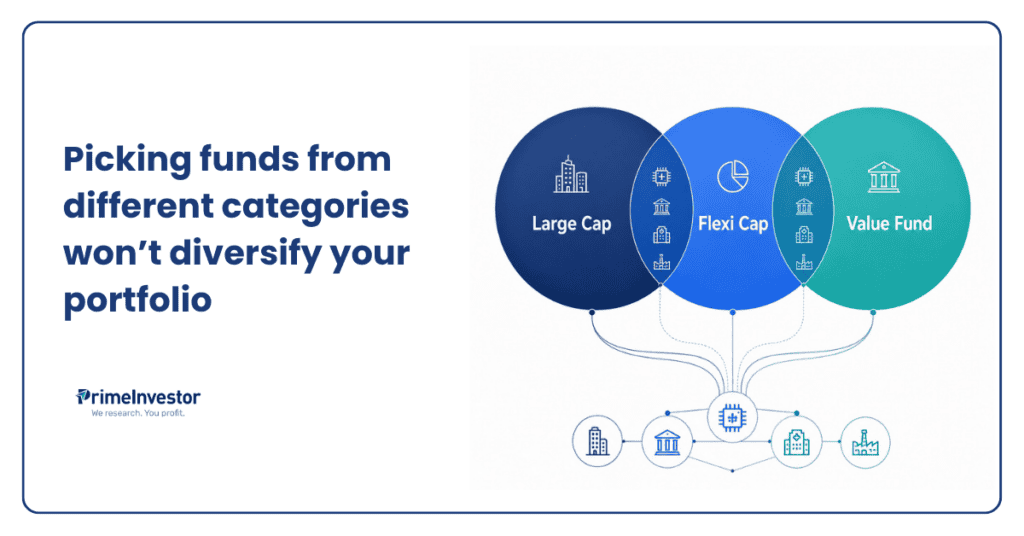
Two funds sitting in entirely different SEBI categories can end up remarkably similar on the inside. And in the same way, two funds in the same SEBI category can look very different! So, investors may inadvertently end up with more overlap. Or may be taking on more risk, or then missing better options simply because they sit in a different category.
In this report, we delve into how equity fund categories are defined, how they may overlap, and how investors need to look for fund choices in portfolios.
SEBI category definitions
In equity funds, SEBI categorization is done based on two aspects:
- Strategy-wise: The fund the strategy follows – this is value, contra, focused, and dividend yield
- Marketcap-wise: The allocation a fund needs to have to each marketcap segment – this is large cap, midcap, smallcap, large-and-midcap, multicap, flexicap. ELSS is defined solely on tax benefits.
The problem lies here: Each fund’s character is defined both by its strategy AND its marketcap make-up. What do we mean by this? Take HDFC Flexicap. This comes under the flexicap category. This fund has a large-cap tilt with about 75% of its portfolio in largecaps. Now consider ICICI Pru Value. This comes under the value category, but also follows a value strategy and has a large-cap portfolio bias. Both funds, though classified under different categories, still share the same characteristics and are eminently comparable.
Therefore, classifying equity funds based on either marketcap or strategy means that there will always be overlap between categories.
How categories share similarities
Marketcap orientation is a good indicator of similarities in funds and the risk-return potential. Given below are the large-cap and mid-cap allocations across categories. This is based on April 2026 portfolios, but the trends are largely similar in earlier periods as well.
From the data above, the following observations can be made:
- Some of the more flexible categories – flexicap, strategy-based – all drift towards being largecap or midcap oriented on an average. For example, dividend yield behaves more like a large-cap fund in terms of composition. You can find largecap orientation in flexicap funds and focused funds as well.
- Funds tapping the mid-and-smallcap segments can be found in multiple categories as well. Apart from pure mid-cap category, these include large-and-midcap, and even contra.
- The multicap category offers the most small-cap play outside the pure smallcap category. This means, if you combine a multicap with a smallcap in your portfolio, you are adding significant risk (and return potential) to your portfolio.
- The fund category label does not always disclose the inherent marketcap risk or strategy risk in a fund. In the more flexible categories especially, there always are funds that lie outside the normal range for the category. For example, the highest smallcap allocation in the flexicap category is about 38%. In the focused category, it is at 33%. The dividend yield category has a fund with a 34% smallcap allocation. If you did not realize this, you may be investing a riskier fund than the name implies.
- The data above does not show strategy overlaps. But this is another aspect where funds from different category adopt the same approach. For example, a midcap or say a flexicap fund can also have a focused strategy, which ups the risk compared to others within the category.
- Thematic funds are another category where overlaps emerge. The thematic category covers a very wide variety of funds. There are focused themes like healthcare or consumption. But there are also very broad-based themes like special opportunities, business cycles, and innovation which sport diversified portfolios that are eminently comparable with flexicap or multicap funds.
Why similarities are important
Performance comparison: When a fund is evaluated only against its category peers, it will not show the complete picture since there are funds belonging to other categories that are also comparable. Category-level comparisons can flatter funds, especially if that category is small, such as contra. The real picture only emerges when you compare across similar actual compositions. For example, Axis Value may look reasonable compared to other value category funds. However, when compared to the broader universe of flexicap funds, those such as HDFC Flexicap are better and more consistent outperformers.
More informed fund selection: Once you see through category labels to actual allocations, your universe of choices expands. It gives you far more flexibility to find the right fit for your portfolio. For example, if you are looking for value funds, you could find it both in the value category as well as the flexicap category. If you’re looking for mid-or-smallcap to boost returns, there are several categories that fit, including multicap, smallcap or midcap, or focused funds may also be a fit.
Avoiding inadvertent overlap: A portfolio built across four or five categories can still end up heavily concentrated in a particular strategy/marketcap composition if each fund independently tilts that way. Take the focused category for instance. Canara Robeco Focused Equity is large-cap based with about 80% in the segment. It shares approximately a 46% overlap with ICICI Pru Largecap and Nippon India Largecap Fund. Kotak Largecap and Kotak Contra, while belonging to different categories, share a 49% overlap.
Understanding the real risk & return: In some categories, the name alone may not indicate the true underlying risk and consequently return potential. A mid-cap oriented contra fund may be higher on the risk-return measure. A dividend yield fund may be more conservative than you thought.
Therefore, for an investor trying to build a diversified portfolio, simply picking one fund from each category won’t guarantee diversification. The within-category variation is also large, making fund-level allocation more important than category allocation.
A Rs 30 crore client portfolio we recently reviewed in our PMS, for example, had exposure to the flexicap, focused, midcap, multicap, and smallcap categories. But the fund choices resulted in a good amount of overlap which could have been easily avoided given the size of the portfolio. For example, the portfolio held Franklin India Flexicap, Kotak Flexicap, and Franklin India Focused Equity. The two Franklin funds had a 44% overlap. The overlap with Kotak Flexicap was also around 36-45%. So while there was category diversification, there was lower real portfolio diversification.
To summarize, categories are a useful starting point. But they are not the solution to a properly built portfolio. When you are deciding allocations, first determine what allocation you need to have to moderate-risk, large-cap based funds and what proportion to dedicate to aggressive, high risk-high-return funds.
Then, look at all categories that meet the requirement of these two buckets. For moderate-risk allocations, categories such as largecap, flexicap, value/contra, and focused can offer good opportunities. For the aggressive part, the categories to choose from are primarily midcap, smallcap, large-and-midcap, multicap.
If you are struggling to manage a large portfolio that suffers from holding too many funds and resultant overlap, learn more about our portfolio management service (PMS) here.