
Small finance banks, with their focus on small ticket loans for urban and semi-urban India, are a play on the underpenetrated market for financial products in India. Players who’ve bagged SFB licences have managed scorching loan book growth with Net Interest Margins (NIMs) and Return on Equity (ROE) far superior to traditional universal banks. Yet, after stellar performances soon after their IPOs many of these stocks have seen their valuations levelled. So, when a new candidate – Suryoday Small Finance Bank IPO (Suryoday) comes out in an overcrowded primary market, how should it be judged? Read on.

About the bank
Suryoday started operations as a micro finance player in 2009 and became an SFB in 2017. It does not have a holding company structure like some of the listed peers such as Equitas or Ujjivan, which is an advantage. The primary purpose of the IPO is to comply with RBI’s norms of listing within 3 years of incorporation of a Small Finance Bank in India. The bank has come out with an IPO of Rs 582 crore at the higher end of the price band of Rs 303-305. About 57% is an offer for sale by existing investors and 43% is fresh issue that would enhance capital adequacy. The offer closes on March 19, 2021.
At the higher end of the price band, the bank’s market cap post listing would be about Rs 3,200 crore.
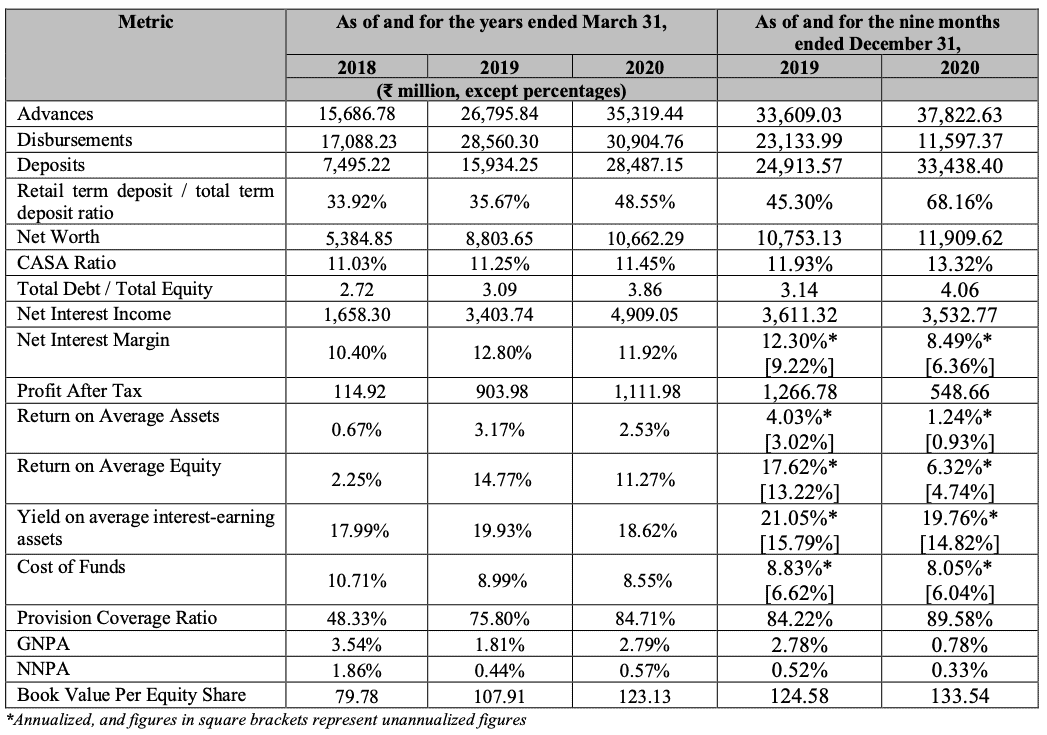
The image below will give you a summary of the bank’s key metrics, pre-issue. Date is sourced from the offer document.
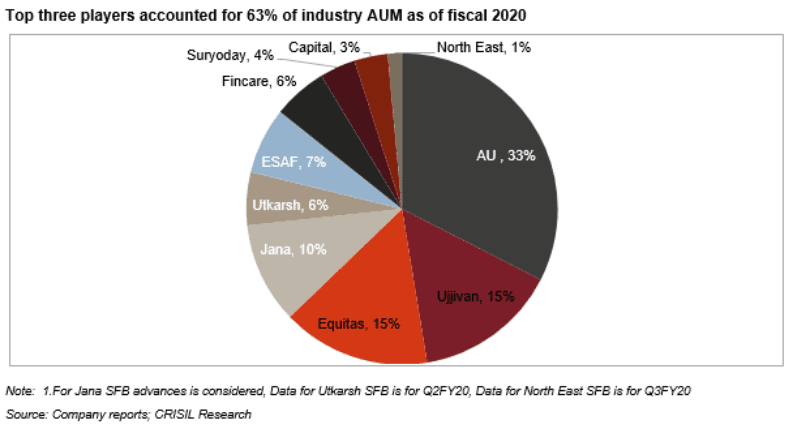
Suryoday, is clearly among the smaller players in the SFB space, in terms of assets under management. Data below will tell you that the top 3 players garner over 60% of the market share. In other words, it is not an industry leader.
Positives
#1 High growth in assets and deposits
Suryoday has had a trail blazing growth in advances at close to 50% CAGR between FY-18 to FY20 – superior to all other listed SFBs and matched only by universal bank Bandhan Bank. The bank managed to grow its advances by 7% between March 2020 to December 2020, at a time when closest peer Ujjivan saw a decline. Similarly, deposits jumped 4-fold between March 2018 and December 2020 (to Rs 3344 crore).
Two-thirds of its advances come from metropolitan and urban regions, thus significantly improving its prospects for growth. Presence in high-demand states of Tamil Nadu and Maharashtra (together accounting for 62% of advances) heightens its prospects for growth.
#2 High yields
Suryoday scores across profitability metrics. The data given below (source RHP) for FY-20 will tell you that the yield on advances and net interest margin are healthy. As a result, the cost to income ratio at 47% for FY-20 is the lowest among SFBs and even lower than universal banks like Bandhan.
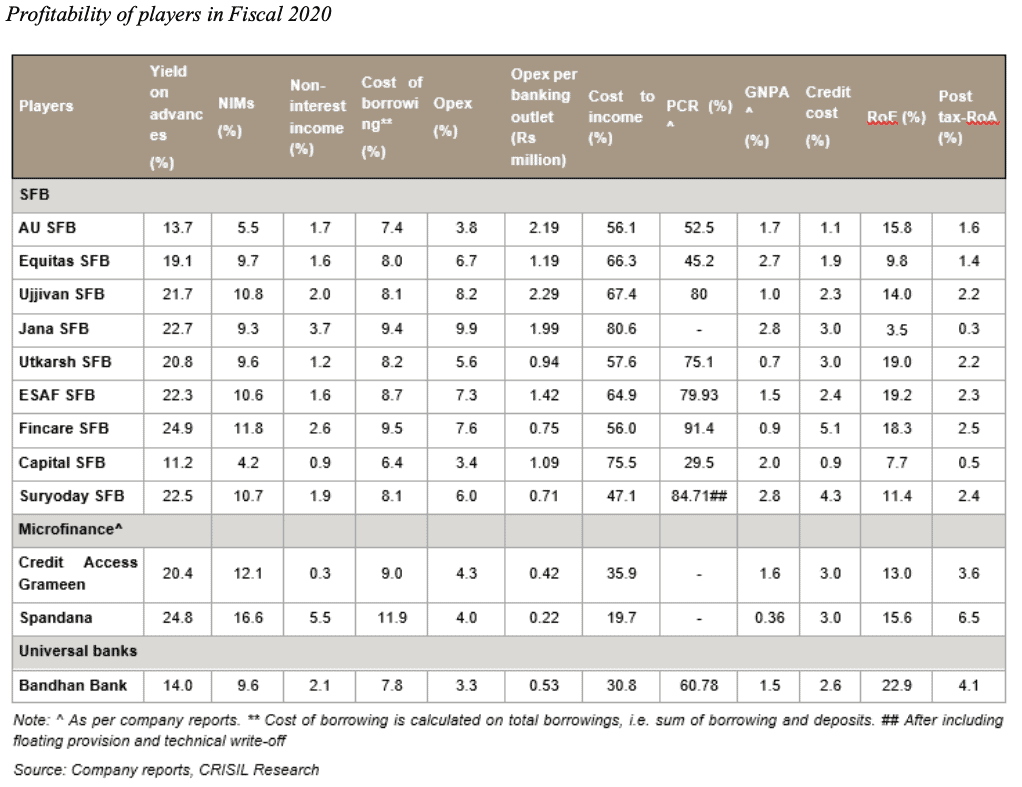
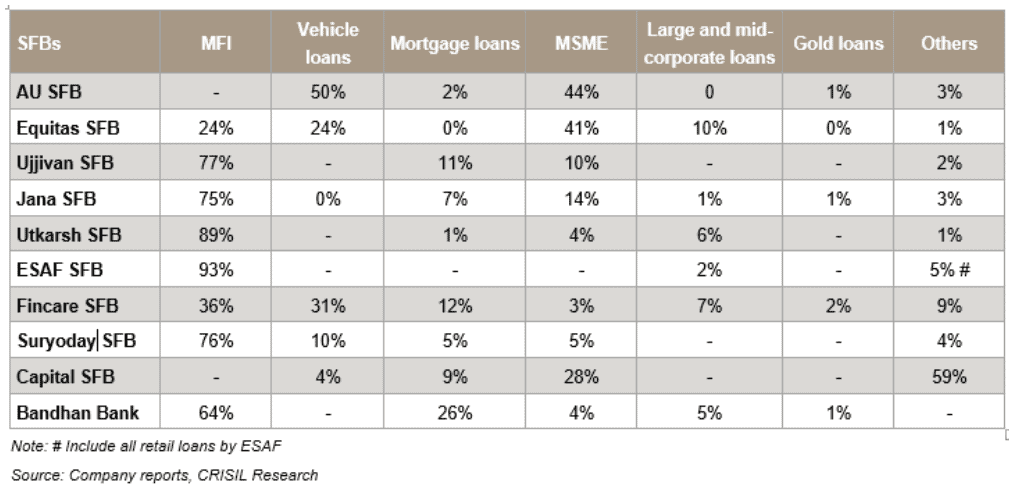
The superior profitability is a mixed blessing because it indicates a riskier loan book. The data below shows that high exposure to micro finance segment is the margin-clincher for Suryoday. Among the listed players, you will notice that Ujjivan has a similar profile with almost similar profitability metrics while leaders such as AU SFB have a higher non MFI contribution.
#3 Highly capitalized
Suryoday’s capital adequacy ratio (CAR) was at 41% (Tier I and II) as of December 2020, against the regulatory requirement of 15%. This is significantly higher than Ujjivan’s CAR of 28%.
With pre-IPO fund raising as well as post IPO this will move well above the 50% zone making it the best capitalized play among SFBs as well as universal banks like Bandhan. This provides Suryoday with extra cushion not just to pursue high loan growth, but also to absorb any loan losses from Covid related distress.
Risks, Valuation and Recommendation
Risks
#1 Presence in high-risk segments
Suryoday has reduced its exposure from the high-risk, high returning segment of micro finance, from 95% of advances in FY-18 to 76% for the nine months ending December 2020. But this segment remains the primary growth and profit driver. While much of this lending is unsecured, Suryoday claims that its unique approach of forming ‘joint liability groups’ where group loans are disbursed on peer-guarantee model helps ensure better credit discipline. The target customers are women and interest is anywhere between 20-26%. While this model may seemingly mitigate risk, there are factors that offset this. For one, such loans may well be consumption loans than business loans, going by the ticket size of Rs 10,000- 52,500. Second, the urban and semi-urban population has been more hit by loss of income during the pandemic and this is the predominant segment for Suryoday, thus heightening default risks. Markets too tend to perceive MFI focussed SFBs as far riskier than those with other exposure.
Assuming Suryoday does diversify further away from this segment, as have many SFBs, the high margins enjoyed now may not sustain. Segments such as commercial vehicle loan in the lower income space, are also traditionally prone to high NPAs. Ujjivan, which has a similar advance profile commands around 1.8-times book value, a discount to the asking price by Suryoday.
#2 CASA needs shoring up
For SFBs, diversification in product profile away from high yield microfinance reduces risks but also shrinks NIMs. The main way to keep margins from sliding significantly would be to keep cost of funding low. And that is achieved through CASA (deposits through current account and savings account). This is one reason why so many small finance banks are keen to get you to open a savings account with them!
On this front, Suryoday has a long way to go. Data below shows how peers are ahead of the bank in terms of their ability to attract CASA. Suryoday would need to attract low cost deposits to keep its cost profile attractive, even as it diversifies its loan mix.
#3 Geographic risks
Maharashtra, Tamil Nadu, and Odisha account for 77% of the gross advances of Suryoday. This concentration needs to come down. Peers like Ujjiivan SFB for instance has under 45% exposure to their top 3 states of Tamil Nadu, Karnataka, and West Bengal. At a time when loan waivers are in vogue, exposure to election bound States like TN can pose risks should populist policies destroy credit culture. Politically populist measures can impact asset quality more, when the portfolio is concentrated.
#4 Asset quality risk looms
With Covid hitting incomes and regulators extending special dispensations, markets have begun to focus on asset quality to the exclusion of most other parameters in valuing banking stocks. Post the moratorium granted to borrowers (extended till August 31, 2020), declaring accounts as NPAs has been kept on hold by the Honorable Supreme Court of India. As a result, most banks have not provided for their bad loans in full in their published results. Had Suryoday classified borrower accounts as NPAs post August 31, 2020, its gross NPA ratio would have been 9.28% on a proforma basis. This is a significant jump over its declared NPA of 0.78% and is alarmingly high when compared with peers.
These off-book NPAs could require higher loan loss provisions and dent profits in the coming quarters once the moratorium is lifted. While Suryoday has capital buffers to absorb this it’s profit and growth metrics can suffer.
This risk appears heightened given the micro finance-heavy segment profile of Suryoday. The bank has stated that it holds a Covid-19 related buffer of Rs 140 crore (3.7% of loan book). Collections (as measured by number of paying customers) for Suryoday has improved from 42% in June 2020 to 82% in December 2020 but was higher at 95% for Ujjivan SFB in December 2020.
Valuation and recommendation
On a post-issue basis, Suryoday will trade at 2.1 times its book value at the upper end of the price band. This is not too high. But it needs to be kept in mind that barring AU Small Finance Bank, all other SFBs have seen a derating of in their valuations post listing, especially post Covid. The only exception being AU, for its zero presence in the risky micro-finance segment. Ujjivan SFB is currently at 1.8 times book. But what needs to be remembered is that its advances is 3.5 times that of Suryoday’s, and deposit at 3.8 times.
We would rather wait to see a higher product/geographic diversification from Suryoday and the true picture on NPAs; besides, see SFBs take a one-time hit on their balance sheets when the Covid-19 related bad loans are eventually written off (once Supreme Court gives the signal). The risk-return payoff may be better then.






4 thoughts on “Suryoday Small Finance Bank IPO – Invest or avoid?”
Dear Vidya ji,
Well presented and with comparable SFBs. The risks are well brought out. A good , guiding article.
bala
Thank you sir. Vidya
They are still managing to give FDs at 6.75% for any amount which is more than other peers combined. How does it affect their viability?
Most SFBs do it to get CASA/deposits. It will mean high cost initially but do remember that they also lend at high rates given that their borrowers are high risk. thanks, Vidya
Comments are closed.