
POWERGRID Infrastructure Investment Trust (Powergrid InvIT) is the third InvIT and the second in the power transmission space (the other being IndiGrid InvIT) to be listed in the Indian stock markets. It is sponsored by listed PSU Power Grid Corporation of India (PGCIL and henceforth called the Sponsor).
Please find an explanation of what an InviT is here. This article will give you only our quick take on the offer and whether it is suitable for you. It is not a deep dive into the InvIT’s business and financials.
But before that you need to know how InvITs work as an investment product for you.
How InvITs work as investment products
InvITs are hybrid investment products – they have some features of debt and some of equity. The debt features come from the requirement that these instruments should distribute 90% of their net income to unitholders. This will be in the form of interest, dividend, or other payments. Such cash pay-outs come from the underlying assets that the InvITs hold. For example, the transmission charges that the PGInvIT receives is the primary revenue source that generates cash flow. This is adjusted for various expenses to arrive at what is called the net distributable cash flow, which is then paid out to you.
The equity feature comes from the capital appreciation in the price of InvIT units. This happens either because the underlying assets become more lucrative or more commonly, because more assets are added to the portfolio of the InvIT.
Simply put, your profit/return comes in two forms:
- Interest, dividend, or other pay-outs. Typically, the first are quarterly payments.
- Capital appreciation or depreciation if any.
But InvITs also suffer because they are in between equity and debt – InvITs can neither boast of being a full-fledged equity growth vehicle nor can they claim to be a safe/steady income-generating option. Here’s why.
Quasi-equity: Unlike stocks, InvITs cannot be expected to be high-growth, wealth generation stories as they are primarily vehicles that will distribute their profits and largely depend on debt to add to assets to expand. And if the assets they choose are suboptimal or bad, or their income generation capacity goes down, it impacts the income part of your investment as well, which in turn reduces the InvIT’s attractiveness which reflects in its market price.
IRB InvIT for instance is now at half the price at which it listed in 2017 due to several unfavourable factors. The other listed play Indigrid did better by aggressively adding assets. Yet, the appreciation in its unit listed price (not including distribution) was at 6.3% annually since June 2017. The point here is that these are not meant to be wealth builders to your portfolio.
No fixed coupon income: Unlike a deposit or bond, InvITs are not required to pay you a fixed coupon/interest rate. They are required to distribute 90% of the net cash flows (after interest cost, other expenses and deductions, trust management fee etc.)
The pay-out here is measured by the ‘yield’ – which is nothing but the pay-out per unit you receive divided by the price at which you bough the InvIT. However, this term yield is different from debt instruments. In debt, the numerator – the interest or coupon amount is fixed. Only your bond price may vary. However, here, the numerator, the distribution per unit can also vary. Hence, it is not similar in risk or return to a pure debt instrument.
Taxation complexity: The tax impact for you depends on the way the InvIT distributes the pay-out. The interest distributed on InvITs is taxable and a withholding tax of 10% is deducted. For dividend, there is an added layer of complexity. Dividend distributed is taxable in your hands if the underlying assets (special purpose vehicles or SPVs) have opted for beneficial tax regime under Section 115BAA of the Income Tax Act. Otherwise, they are exempt. If they are taxable, then withholding tax applies.
In the case of PGInvIT, while there is no mention of 115BAA benefit being availed, there are some tax holidays in some of the SPVs and hence it is not quite clear whether the dividends are taxable or not. You would need to look up to the InvIT to clarify this. Most InvITs and REITS put out a note on taxability.
Capital gains taxation is similarly a blend between equity and debt taxation. If you hold a listed InvIT and sell it in the market (STT paid) within 36 months, you will have short term capital gains at 15% (plus surcharge and fees). For holding period longer than 36 months, it is long term gains taxed at 10%. (for gains more than Rs 1 lakh, including LTCG in other instruments like stocks).
Summary: InvITs are more risky than regular debt instruments and hold less return potential than regular equity instruments.
Powergrid InvIT Offer details, Positives, and Limitations
Powergrid InvIT offer details
PGInvIT has now come up with an IPO that will close on May 3, 2021. At the higher end of the offer price of Rs 99-100, PGInvIT’ s market cap will be about Rs 9,100 crore. At the higher end of the band, the offer size is at Rs 7,735 crore. Of this, Rs 2,742 crore is an offer for sale by the Sponsor and Rs 4993 crore is fresh issue. The fresh issue will be utilised to lend to the assets (SPVs) to prepay debt availed.
The minimum bid size is Rs 1 lakh and bid lot is 1100 units and multiples of 1100 units thereafter. See more details in offer document.
Powergrid InvIT
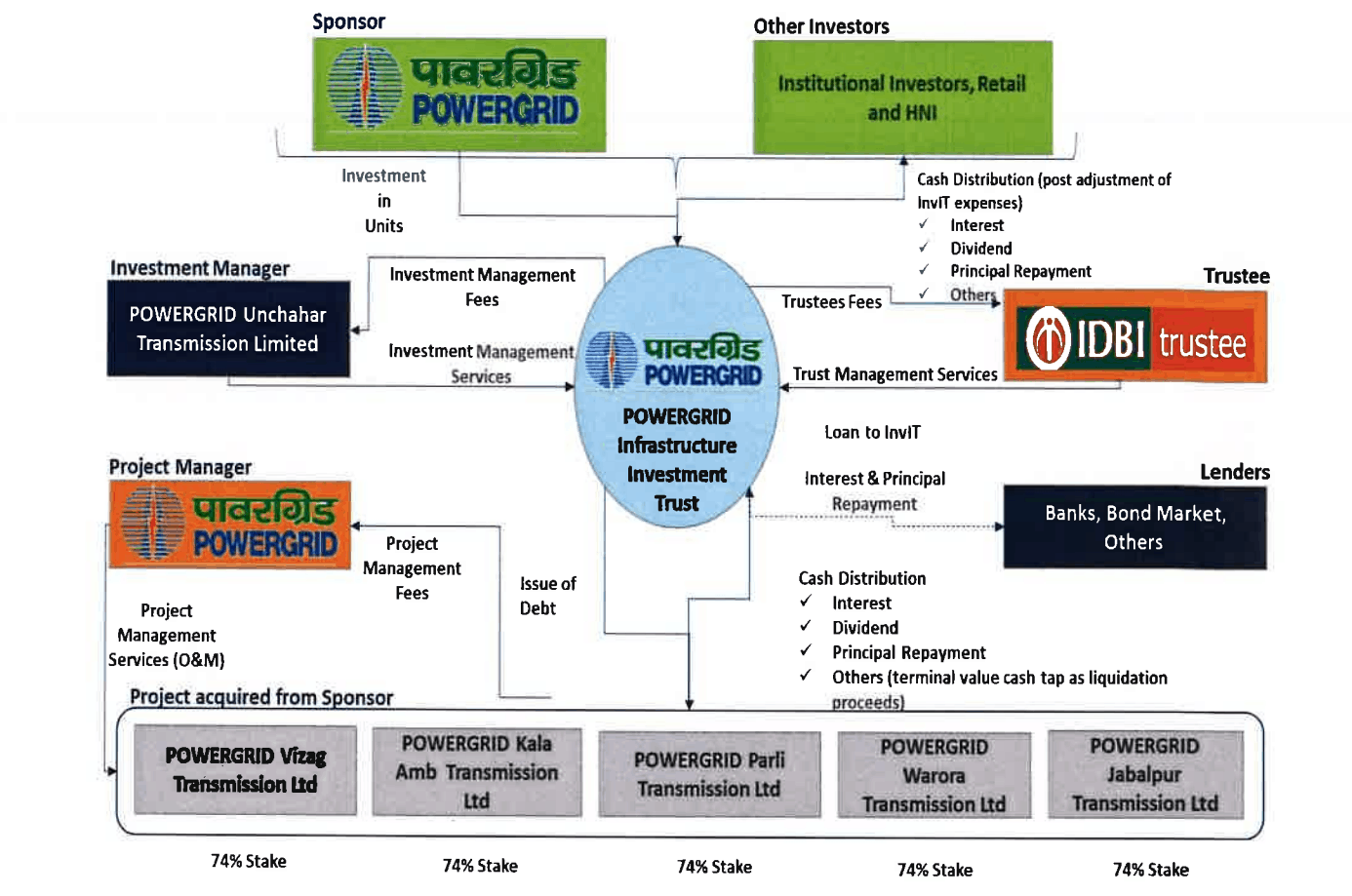
PG InvIT is sponsored by Power Grid Corporation of India (Sponsor). This InvIT is a newly formed one with no track record. The Sponsor will offload its stake in five assets – called initial portfolio assets – to PGInvIT. These five assets with be the ones housed under this InvIT.
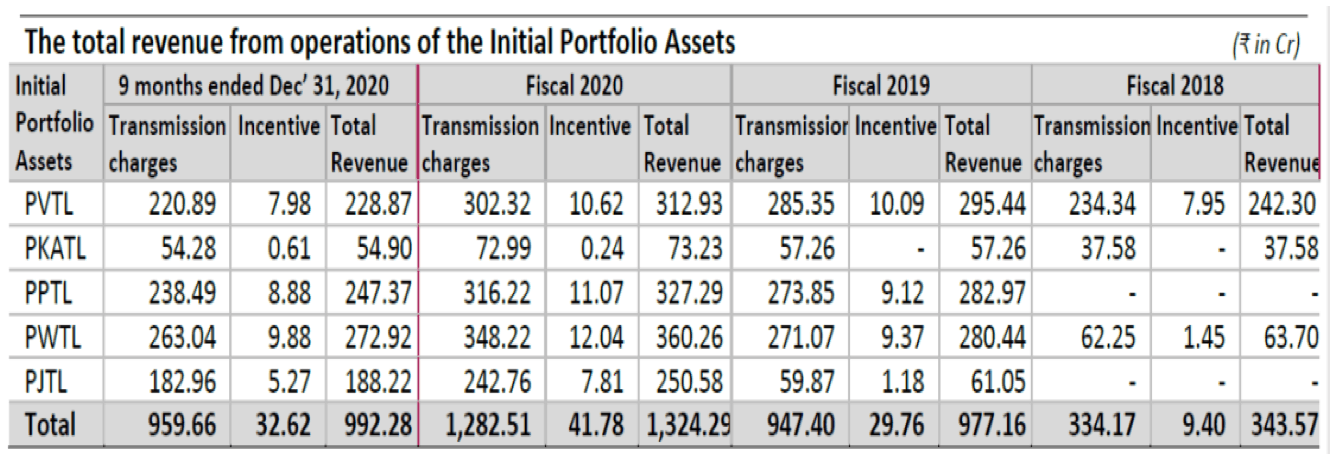
The 5 transmission assets will have a total network of 11 power transmission lines of about 3700 circuit kilometers and three substations having 660 MVA of transformation capacity (as of Dec-20). The revenue from these assets come from availability-based transmisson charges that the assets generate. The InvIT has not generated any revenue per se as it is newly formed. The data given below is for the seprate assets that are currently housed under the Sponsor.
Positives
#1 Stability in cash flows
The transmission charges are already fixed for a period of 35 years, of which another 32 years remain for the five assets. This lends cash flow visibility. The assets also typically have a useful life of 50 years and the agreements are renewable, thus providing further cash flow visibility.
Irrespective of the actual power transmitted, incentives are provided for ‘annual availability’ of power at 98%. As PGCIL has been steadily managing this, it can continue getting incentivised and the possibility of penalty is low. Please note that the growth in revenue and PAT that you see in the table is because of operationalisation of some of the assets and not an organic growth. Hence, the numbers are not strictly comparable.
#2 Sound backing by seasoned Sponsor
The Sponsor PGCIL enjoys an 85% market share and revenue share in the power transmission space. Hence, it is not only well-placed to bid and win projects, as it has in the past, but also hive off assets into the InvIT. Sponsor PGCIL has 18 other projects in various stages of execution and while the InvIT does not have any right of first refusal, if the Sponsor decides to recycle them, it will likely be the preferred channel to monetise such assets. In other words, the InvIT can expect some asset addition through the strength of its parent. Growth/addition of assets is critical for an InvIT to appreciate capital and grow cash flows.
# 3 Attractive yield for now
At the higher end of the offer price, if we consider the expected net distributable cash flows for the next 3 years (as given by an independent valuer in the RHP) of about Rs 1,100 crore, then the yield works out to 11-12%. This yield looks quite attractive and higher than peer Indigrid’s yield of 9.5-10% at present (based on FY-20 distributions). But read more about why this may not sustain later in the ‘limitations’ section.
Limitations
#1 Revenue and cash flow decline
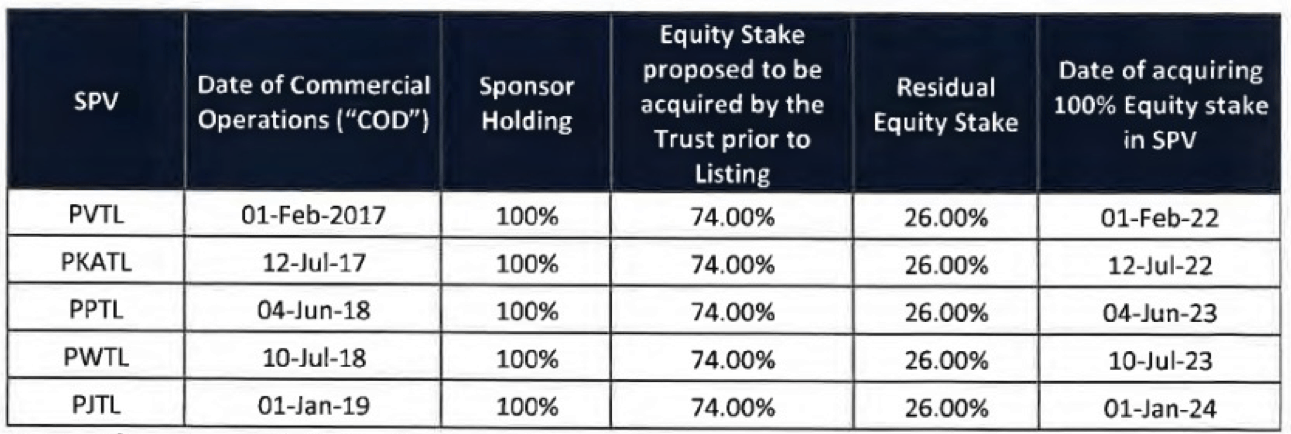
It is to be noted that over the next 1-3 years, Powergrid Invit is required to buyout the remaining 26% stake of the Sponsor. It will likely have to fund these through debt and the interest cost incurred on that will reduce the profit/distributable cash flows. Since we do not know at what valuations this buyout will happen, we cannot quantify the interest outflows for this purpose. But what it means is that the current attractive yields may not sustain over the next 3 years, probably settling at 9-10 percent levels if the stake is taken over at current valuations.
The data below will tell you that the external valuation report has factored marginally lower cash flows.
While the revenue from transmission charges is fixed, they are not steady. From the external valuation report, we gather that there will be a tariff decline from FY-28 as tariff lowers. This will mean that unless PGInvIT aggressively adds assets to its portfolios, investors will see stagnant- to-lower distributable cash flows.
Besides, operating expenses also appear to be creeping up (according to the estimates), accounting for inflation in operating and maintenance of these assets. In other words, lower tariff and marginally higher expenses means, with time, the current portfolio of assets will yield lower. While we have no way to estimate this accurately, for this present portfolio, what is clear is that the yields will steadily decline, especially from FY-28 – assuming no portfolio addition.
#2 Cash flow delays not ruled out
Given the nature of the customers for inter states transmission (States), delays in cash collections cannot be ruled out. For example, receivables due for over 120 days was just 9% of total receivables as of March 2019 but went up to 22% by March 2020 and settled at about 19% as of December 2020. Pressure in smooth collection can lead to volatility in cash flows, disrupting regularity of distribution by the InvIT. Hence, investors need to tone down their expectations of steady pay-outs.
#3 Lacking track record
While the backing by a sound Sponsor like PGCIL, provides confidence, Powergrid Invit is a new trust with no track record. An InvIT is typically assessed based on its ability to distribute cash (yield on your investments) and ability to add assets to its portfolio (capital appreciation in your investment). At this juncture, none of these are tested.
Suitability
- Powergrid Invit is not suitable if you’re looking for equity wealth building – like a typical stock. In fact, its Sponsor PGCIL may benefit from periodically recycling assets and hiving them off to the trust and generating cash flows through that process. The price to book of the Sponsor (PGCIL) at 1.7 times is not expensive considering the post-issue price to book for the InviT will be at about 1.4 times. And importantly, PGCIL will not be constrained by a declining EBITDA from lower tariffs like the InviT’s portfolio.
- Powergrid Invit is not suitable if you want steady/regular income and looking at this as a primary source of income. The vehicle, as explained in the beginning, is far riskier than regular debt options and is not fixed in its income generation. There can also be capital losses, like a stock. This cannot be the primary investment for any senior citizen or regular income seekers.
- If you are not dependent on this investment for steady income and have low expectations of capital appreciation, then the current yield is attractive over the next 1-3 years. However, in this period, if prices do fall, you should be able to stomach the losses.
Overall, unless you fall in the last category mentioned above and simply want diversification, we do not find a compelling case to invest in the Powergrid InvIT until we see more addition of assets.






16 thoughts on “PowerGrid InvIT – should you invest?”
This is something I should take time to read and to know more information about power grid invit . I absolutely love how you down it.
https://www.indigrid.co.in
TL;DR: AVOID for most people!
Can these units be bought and (more importantly) sold freely like a stock? If yes, what is the liquidity expectation?
Yes. Will be known only when they list, based on demand supply. thanks, Vidya
Dear Madam: Thanks for your analysis. Could you please tell us if the issue will be reasonably liquid post listing. Regards!
Will know only post listing. thanks, Vidya
Well written and analysed. Thanks a ton. So in effect, will it be advantage powergrid ? will it help reduce the debt that they carry on their books?
Warm Regards
Shravan
Sorry, if I did not convey right. We only said it is better placed if one is looking at growth compared with the InvIT. it is not a recommendation among stock opportunities 🙂 Also, this is not a call on PGCIL. thanks, Vidya
Hello, Since debt of powergrid will be reduced now, whether powergrid can be bought? Also in this case the value of operational assets will not be on its books since it has been transferred out? What will be the impact of this hive off on powergrid (not InvIT) business? Can you pl. Clarify?
What will be the rationale for buying powergrid instead of InvIT?
This is beyond the ambit of this discussion and also we did not say buy PowerGrid instead of Invit. We said, the parent and invit are trading at similar valuations with parent commanding higher margins. thanks, Vidya
Out stock discussions are restricted to those in our Prime stocks coverage. thanks Vidya
In the midst of all marketing hype of this InvIT, a calm analysis such as this was most wanted. Clearly articulated !
Thank you! 🙏 Vidya
Good analysis. You started the article with a comment this product is suitable only for one type of investor. Which of investor?
Thanks. it is mentioned in the end, under subscriber section. thanks, Vidya
Comments are closed.